








Sell medical devices in the EU from United Arab Emirates · MDR / IVDR Article 11

EU Authorized Representative for UAE manufacturers.

Our name goes on the label only after your file stands up to review.

A manufacturer established in the United Arab Emirates is outside the European Union for MDR and IVDR purposes. Marketing authorisation for a medical device in the UAE is issued by the Emirates Drug Establishment and is separate from the Union route. MEDDEV reviews the available home-market evidence, defines the EU file and accepts the Article 11 mandate only when the documentation and liability criteria are met.

For UAE medical-device and IVD manufacturers preparing EU market entry, transferring an existing mandate or coordinating EUDAMED responsibilities.

European Union flag
Established in the European UnionWarsaw, Poland · EC REP under MDR and IVDR Article 11
Online intake Secure connection

Apply for MEDDEV mandate review

A short, three-step intake. We confirm eligibility, define the review scope and decide whether to proceed.

Step 1 of 3 · Manufacturer

No document upload at this stage · reply usually the same working day · in English

Confidential files are handled separately through one-time access, private EU storage and automatic deletion after expiry. Review our security and data handling controls.

MEDDEV brand serving medical-device companies since 2012 MDR 2017/745 & IVDR 2017/746 Mandate accepted only after review
Manufacturers who have worked with MEDDEV
CHM Sp. z o.o.MDD Sp. z o.o.WDI Wise Device EuropeGlobal Pharma CMSensiMedUSP ZdrowieAdamed Consumer HealthcarePiórex S.A.
United Arab Emirates → European Union

Untangle the local structure before the mandate inherits it.

In the Emirates, marketing authorisation for a medical device is issued by the Emirates Drug Establishment, normally for five years, and the applicant is a locally licensed entity — a medical warehouse, marketing office or local manufacturer — supported by an agency contract. The application file typically contains a certificate of free sale from the country of origin and a conformity certificate such as an EC certificate or an FDA 510(k) or PMA. The EU route inverts that structure: obligations sit on the legal manufacturer itself — as defined in Article 2(30) of the MDR and Article 2(23) of the IVDR — evidenced by its own technical documentation. MEDDEV starts by establishing who that manufacturer actually is among the parties involved.

The authorisation holder is not always the manufacturer

EDE requirements state that the applicant must be a medical warehouse or marketing office licensed by the EDE, that marketing-authorisation-holder companies must themselves be registered with the EDE, and that the application includes a product agency contract. The company whose name is on the UAE authorisation may therefore be an agent, not the manufacturer. In the EU, MDR and IVDR obligations attach to the legal manufacturer, which designates its own authorised representative in writing.

The UAE file can rest on another jurisdiction’s conformity evidence

The EDE application asks for a certificate of quality conformity or marketing authorisation — such as an EC certificate, a 510(k) or a PMA, according to the device class — together with a certificate of free sale from the country of origin. Where a UAE registration was built on such reliance evidence, the EU review has to separate the technical evidence the manufacturer owns and controls from market status granted by another jurisdiction.

The supply-chain roles are institutionalised — and they differ from the EU’s

Federal Decree-Law No. 38 of 2024 defines the marketing rights holder, importer, distributor, medical warehouse and marketing office as distinct licensed roles. The EU defines its own economic operators — manufacturer, authorised representative, importer, distributor — with duties set by MDR and IVDR. The two maps do not overlay neatly, and the mandate should not inherit an ambiguous structure.

Official basis: Emirates Drug Establishment: marketing authorisation for a medical device, Federal Decree-Law No. 38 of 2024 governing medical products, European Commission: authorised representatives, MDR Article 11, European Commission: EUDAMED UDI/Device registration.

Local review focus

What usually needs attention for United Arab Emirates manufacturers.

UAE manufacturers often coordinate several local-market parties. Before an EU mandate, MEDDEV identifies the legal manufacturer, authorised signatory, device families and EU importer so that the mandate and EUDAMED records do not inherit an ambiguous supply-chain structure.

Qualification file

What to prepare for the first EU review.

The initial website form contains no document upload. After the parties and scope are confirmed, MEDDEV provides a controlled transfer route for the records below.

  1. 01

    The actual entity structure: the legal manufacturer, the UAE marketing-authorisation holder, the agent and any group relationships between them, with signatory powers evidenced.

  2. 02

    EDE marketing-authorisation certificates per device family, with the underlying file — including any EC, 510(k) or PMA certificates and certificates of free sale the application relied on, and who holds them.

  3. 03

    Conformity evidence the manufacturer owns outright: technical documentation, quality-system certificates, clinical or performance data, separated from documents held by agents or other authorisation holders.

  4. 04

    Intended purpose as it will be worded for the EU market, with the MDR or IVDR classification rationale built from the Union rules.

Typical transition gaps

Issues to resolve before the mandate starts.

The local agent read as an EU representative

The UAE system runs on licensed local entities and agency contracts; the words are close enough to invite confusion. The EU authorised representative is designated by the legal manufacturer under Article 11 of the MDR or IVDR, with statutory duties and liability conditions defined by the Regulation. A UAE agency contract does not create, and cannot substitute for, that mandate.

Ambiguous structure inherited into the EU file

Where the UAE authorisation holder, the label entity and the factory are three different parties, the EU documents have to name one legal manufacturer consistently — on the declaration, the label, the mandate and in EUDAMED. Settling that question first prevents reworking every downstream document.

Class read across instead of re-derived

The EDE page describes device classes I to IV. The vocabulary resembles the EU’s but the rules are not the same, and the EU class — which determines the conformity route and notified-body involvement — is derived from the MDR or IVDR classification rules each time.

EUDAMED is no longer a future obligation

Four modules — actor registration, UDI/Devices, notified bodies and certificates, and market surveillance — have been mandatory since 28 May 2026 under Commission Decision (EU) 2025/2371 and Regulation (EU) 2024/1860. For devices placed on the market earlier and still being placed on the market, Regulation (EU) 2024/1860 allows no later than twelve months from publication of the Commission notice, which was published on 27 November 2025. Registration data therefore belongs in the market-entry plan, not after it.

Financial coverage: what the law says, and what we ask for

MDR Article 10(16) — mirrored for in vitro diagnostics by IVDR Article 10(15) — requires manufacturers to have measures in place providing sufficient financial coverage for potential liability under Directive 85/374/EEC, in a manner proportionate to the risk class, type of device and size of the enterprise. It does not prescribe a particular insurance policy. MEDDEV asks to see those measures because Article 11(5) makes the authorised representative legally liable for defective devices on the same basis as, and jointly and severally with, a manufacturer that has not met its Article 10 obligations. Reviewing the arrangement is our acceptance condition, and that provision is why.

Country-specific route

From home-market records to EU representation.

01

Establish the structure

Document who manufactures, whose name is on the device, who holds the UAE authorisation and what the agency contract actually covers — then test that against the manufacturer definitions in Article 2(30) of the MDR and Article 2(23) of the IVDR.

02

Separate owned evidence from foreign-market status

Record what the EDE file relied on, then identify the conformity evidence the manufacturer holds in its own right and what has to be completed for the MDR or IVDR route.

03

Close the gap list

Complete the technical file review, agree the registration data and coordinate the mandate, labelling and EUDAMED work against the confirmed entity and scope.

Check this portfolio →
Questions from United Arab Emirates

What manufacturers ask before appointment.

Does an EDE marketing authorisation authorise EU sales?

No. It is a UAE authorisation, normally valid for five years — the EDE may grant a shorter term — and its file may itself rest on a certificate of free sale and a conformity certificate from another jurisdiction. Union market access follows MDR or IVDR conformity assessment, CE marking and, for a manufacturer established outside the EU, the Article 11 mandate.

Our UAE registration is held by our local agent. Who deals with the EU?

The EU relationship is built with the legal manufacturer, not the agent. The manufacturer designates the authorised representative in writing, appears on the EU declaration of conformity and label, and is registered in EUDAMED. The agent can remain the UAE-side arrangement; it has no standing in the Union structure unless it is, in fact, the legal manufacturer.

Is the regulator MOHAP or the EDE?

The Emirates Drug Establishment. It was established by Federal Decree-Law No. 28 of 2023, the governing framework for medical products is Federal Decree-Law No. 38 of 2024, and the Ministry of Health and Prevention has announced the transfer of these services to the EDE. Older documents naming MOHAP describe the previous arrangement.

Does every manufacturer from this country need an EC REP?

Article 11(1) of the MDR and IVDR states that where the manufacturer of a device is not established in a Member State, the device may only be placed on the Union market if the manufacturer designates a sole authorised representative. MDCG 2022-16 explains what “sole” means in practice: across a portfolio a manufacturer can have more than one authorised representative where the devices fall under different generic device groups, but for any one generic device group only one. It is a condition of placing the device on the market, not a formality afterwards.

What is reviewed before the mandate?

MEDDEV reviews the legal manufacturer, device identity, classification, conformity route, technical-documentation index, insurance, vigilance arrangements and sanctions screening.

Can documents be sent through the first contact form?

No. The form is for qualification only. A controlled document-transfer route is provided after scope and parties are confirmed.

Post-project client survey

Post-project ratings from real regulatory work.

56published post-project ratings
97%marked MEDDEV “recommended”
5/5 across five criteria WDI Wise Device Europe Readiness audit · 2015
5/5 across five criteria SensiMed Medical device notification · 2015
5/5 across five criteria Piórex S.A. Medical device registration · 2015

Historical MEDDEV post-project survey across regulatory services. Clients rated knowledge transfer, consultant engagement, subject-matter preparation, problem solving and overall service. The individual ratings shown here are from 2015; the summary figures cover the published set from that survey programme. Comments were optional, so most ratings carry none — and no quotation has been reconstructed or written on a client’s behalf.

Acceptance is earned, not purchased

Not every mandate is accepted.

MEDDEV accepts only defined device scopes supported by evidence, working safety controls and a manufacturer we can rely on. A commercial enquiry never guarantees appointment. Our name appears on the label only after the acceptance review is complete.

MEDDEV mandate reviewAcceptance gate
Manufacturer, device and intended purposeAcceptance criterion
Conformity route and regulatory evidenceAcceptance criterion
Safety, post-market and vigilance controlsAcceptance criterion
Communication, response and liability arrangementsAcceptance criterion
Outcome: mandate accepted, conditions issued or mandate declined.
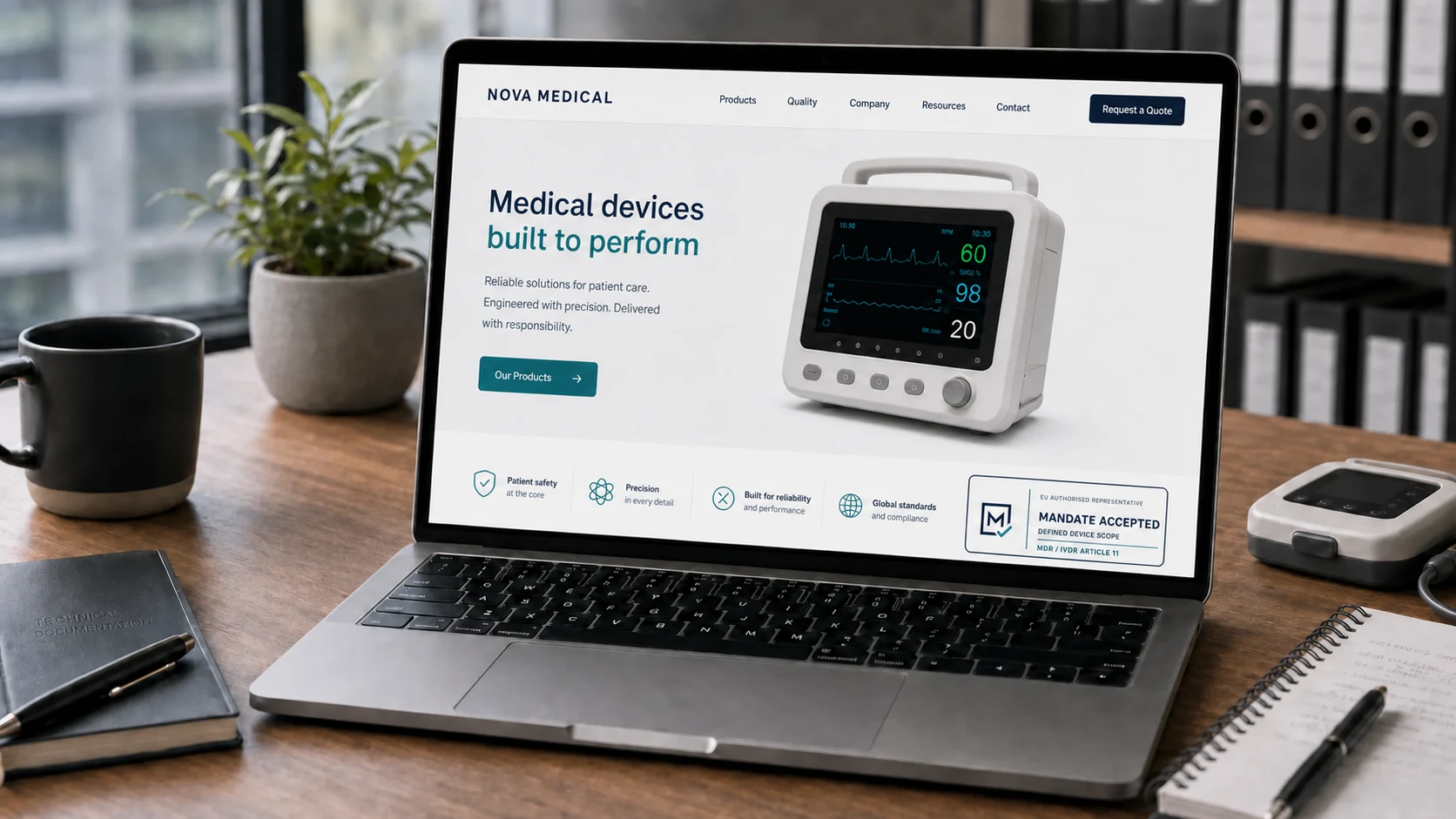
Example of the MEDDEV Mandate Accepted mark displayed on a medical-device manufacturer's website
Example on a manufacturer website. The issued mark should link to the active MEDDEV mandate and its defined device scope.
A status worth displaying

Turn regulatory acceptance into a visible trust signal.

Accepted manufacturers may use the mark where professional buyers assess regulatory readiness. Each use must remain connected to the active MEDDEV mandate and its defined device scope.

  • Manufacturer websiteAlongside EU market-access information and the represented device portfolio.
  • Product catalogueOn pages covering devices included in the accepted mandate.
  • Distributor dossierAs a verifiable representation status during onboarding and due diligence.
  • Sales presentationFor procurement, partner meetings and trade-fair communication.

Use boundary: the mark must not appear as a CE mark, product certificate or safety approval. It should not be added to the regulated device label, instructions for use or sterile-packaging information panel.

Before you enquire

Know what shapes the review and the fee.

We do not publish a one-size-fits-all price because the mandate depends on the device, portfolio and level of responsibility. The initial review identifies the scope before a fee is proposed.

Device and portfolio

Classification, IVD or medical device route, number of families, intended purpose and higher-risk features.

Evidence readiness

Technical documentation, clinical or performance evidence, quality-system records, certificates and labelling.

Ongoing responsibility

EUDAMED coordination, vigilance, authority response, importer interface, PRRC support and required review depth.

Fee principle: after the qualification review, we provide a defined scope and a proposal matched to the accepted mandate. No document upload is required in the first contact form.

01

Legal manufacturer

Confirm the entity, country of establishment, device family and intended EU market.

02

Core evidence

Have the classification rationale, technical-file index, conformity route and quality evidence available.

03

Post-market readiness

Identify complaint, vigilance, field-safety and authority-response owners before the mandate begins.

Check your EC REP readiness →
Typical review scenarios

The questions we resolve before a mandate starts.

These anonymised composite scenarios reflect recurring qualification patterns. They are not attributed client case studies or performance claims; the exact scope and outcome depend on the manufacturer and device file.

01

New EU launch

Problem: home-market approval is mistaken for EU access. Work: map MDR/IVDR, labelling, EUDAMED and importer responsibilities. Typical result: a defined launch route and a documented list of open evidence.

02

Change of EC REP

Problem: the outgoing representative controls records and dates are unclear. Work: plan custody, vigilance ownership and handover steps. Typical result: a controlled transition with responsibilities recorded before the new mandate starts.

03

Higher-risk review

Problem: a Class IIb, Class III or complex IVD portfolio has unresolved evidence or liability gaps. Work: enhanced file and response-readiness review. Typical result: accept, request defined evidence, or decline before exposure is created.

Regulatory briefings

The obligations manufacturers outside the Union ask about most.

Each briefing states the provision it relies on and links to the official text. They are written for companies deciding whether, and in what order, to enter the European market.

EUDAMED · Article 123(3)

Device data falls due on 27 November 2026.

Four modules became mandatory on 28 May 2026. The twelve-month obligation does not cover every device, and the wording decides which.

Read the EUDAMED briefing →
Cyber Resilience Act

Reporting duties start on 11 September 2026.

Products covered by the MDR are excluded. Companion software without a medical purpose, portals and service tools are not.

Read the cybersecurity briefing →
Article 10a MDR

Withdrawing a device now takes six months of notice.

The notice goes to the authority of the Member State where the manufacturer or its authorised representative is established.

Read the supply briefing →
Manufacturers outside the EU

Not every part of a domestic file has to be rebuilt.

What transfers into a European file, what has no equivalent at home, and where a representative is required by law.

Open the compliance hub →
Published acceptance criteria

Six tests every device scope must pass.

Priority goes to complete, traceable applications with a named regulatory owner. Meeting the entry criteria qualifies a scope for a decision; it does not guarantee acceptance.

  1. 01

    Verified legal manufacturer and scope

    The legal entity, authorised signatory, manufacturing sites, device families, models and intended purposes are consistent and traceable.

  2. 02

    Defensible EU regulatory route

    The qualification, classification and conformity-assessment route are documented, with valid notified-body involvement where required.

  3. 03

    Controlled regulatory evidence

    The EU declaration, agreed technical-documentation index, certificates, labelling and registration data describe the same device scope.

  4. 04

    Working safety and post-market controls

    Risk management, surveillance, complaints, vigilance, recalls and corrective actions have current records, owners and escalation routes.

  5. 05

    Responsive manufacturer relationship

    Named decision-makers can provide records, samples and technical answers and can act within agreed authority-response times.

  6. 06

    Liability and continuity secured

    Insurance, contractual responsibility, document access, sanctions screening, change notification and mandate continuity are acceptable.

What the status means: “MEDDEV Mandate Accepted” confirms MEDDEV’s written acceptance of an EC REP mandate for the defined device scope. It is a trust signal about regulatory readiness and the manufacturer relationship. It is not a CE certificate, product approval, independent safety claim or substitute for the applicable conformity assessment.

Present my device scope →
Meet MEDDEV in your own time zone. Live reference times for manufacturer markets. MEDDEV’s registered office is in Warsaw.
Request a 30-minute online meeting
Vancouver–:–
New York / Toronto–:–
Warsaw–:–
Dubai–:–
Tokyo / Seoul–:–
Sydney–:–
The people behind your mandate

Director-level governance. Named specialists for regulatory execution.

Mikołaj Junosza-Szaniawski leads mandate governance, risk oversight and international delivery. Marta Junosza-Szaniawska and Barbara Jęcka-Izdebska remain the named specialists for conformity assessment, registration and ongoing regulatory coordination.

MEDDEV Compliance sp. z o.o. · Warsaw, European Union ul. Mydlarska 47, 04-690 Warszawa, Poland biuro@meddev.pl
Check my eligibility →
Mikołaj Junosza-Szaniawski, Managing Director of MEDDEV EC REP operations and governance

Mikołaj Junosza-Szaniawski

Managing Director · EC REP Operations & Governance

Mikołaj brings more than 25 years of experience at KPMG, including as a Director in Audit Assurance, where he oversaw major sustainability-reporting assurance projects. He combines international project governance with a product-life-cycle perspective encompassing LCA, reuse, recyclability and environmental performance. At MEDDEV, he oversees mandate governance, risk escalation, specialist assignment and continuity of manufacturer communication.

25+ years at KPMG Director, Audit Assurance MBA · Carlson School of Management Specialist LCA training · MIT ESG lecturer · Kozminski University Programme manager · EPD Polska
One accountable contact, specialist depth when the device requires it.

The manufacturer does not need to coordinate a loose group of advisers. The named coordinators define the review scope, assign the relevant specialists and remain accountable for communication and the agreed regulatory work.

Regulatory affairsQuality systemsClinical evaluationPhysiciansBiomedical engineeringSoftware and cybersecurityAesthetic devicesPost-market surveillance
Marta Junosza-Szaniawska, MEDDEV conformity assessment specialist

Marta Junosza-Szaniawska

Conformity assessment & EC REP mandate review

Marta coordinates the initial regulatory assessment, defines the file-review scope and confirms whether MEDDEV can accept the representative mandate.

marta.szaniawska@meddev.pl +48 791 480 270
Barbara Jęcka-Izdebska, MEDDEV registration and notification specialist

Barbara Jęcka-Izdebska

Registration, notifications & ongoing coordination

Barbara coordinates registration and notification work and remains a named contact for the practical steps that follow appointment.

barbara.jecka@meddev.pl +48 730 354 190
Check eligibility →
WhatsApp
Scroll to Top